


AI training controls are becoming part of routine website governance, but editing robots.txt without a clear objective can create confusion. You may want to express a training preference, control search access, or protect private content. Those are different decisions. Before adding a rule, define what you want it to do and check whether the relevant provider currently supports that behaviour.
What changed in 2026
On October 30, 2026, Google announced plans to support a shared AI-training preference signal connected with IETF work. The post says Google aims to support it alongside other providers in 2027. It also discusses existing provider-specific controls. As of this article’s November 2026 research date, that announcement should be described as a plan, not as proof that a new universal control is already enforced everywhere.
Source: Google plans for a shared AI training control. News context checked November 15, 2026.
1. Define what your AI training controls should express
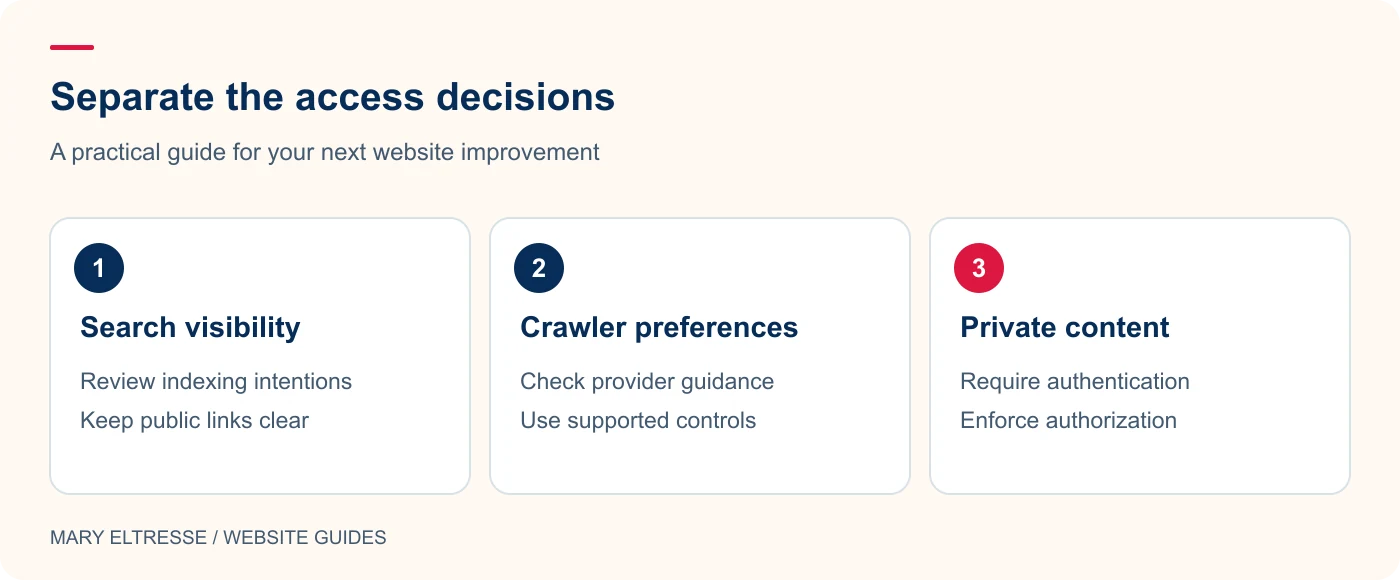
Write a short plain-language policy before writing crawler syntax. Decide whether the concern is use of public text for training, appearance in a particular service, or access to content that should never be public. Identify who owns that decision in the business and who will maintain the configuration. A developer can implement a technical instruction, but should not silently choose the organisation’s content policy. Keep the policy narrow enough that a future maintainer can tell whether a change supports it.
2. Check the provider’s current documentation
Review the exact control documented by each relevant provider and record the date you checked it. Distinguish a proposal, an announced intention, a limited rollout, and an available feature. If an article uses a future date, do not convert it into a present-tense promise in your own documentation. Avoid copying a token from a screenshot without understanding the surrounding rules. This article deliberately does not prescribe a universal robots snippet because a policy decision needs current provider-specific verification.
Example: Hypothetical example: A business wants its service pages discoverable in search but wants to review how content may be used for AI training. List those goals separately, check the current guidance from each provider, and record the rule being considered. Do not assume that one proposed shared control is already supported or has the same effect everywhere.
3. Keep training preferences separate from private access
A preference stated for automated readers is not a login system. Customer accounts, paid downloads, form submissions, backups, and administrative screens need appropriate access controls of their own. Do not place a sensitive export in a public folder and assume a crawler instruction makes it private. Review the live address as a logged-out visitor and check server permissions where relevant. A useful policy should make these layers explicit instead of describing all automated access as the same technical problem.
4. Review changes as a small configuration release
Save the previous robots.txt content and record which lines are changing. Check for contradictory groups or broad rules you did not intend to add. Confirm that the intended file is actually served at the public site address and that a cache or SEO plugin is not overriding it. Do not bundle unrelated indexing changes into a training-preference update. If several people manage hosting, SEO, and content, share the specific change note with those owners before calling the task complete.
Example: Hypothetical example: A paid resource should be available only to members. Protect the page and its downloads with appropriate authentication and authorization. A robots.txt entry asks compliant crawlers to behave in a particular way; it does not prevent someone who knows a public URL from requesting the file. Verify access while signed out as well as signed in.
5. Schedule a review instead of treating policy as permanent
Provider documentation and industry proposals can change. Add a review date and keep links to the official announcements that informed your decision. Where you have reliable server logs, distinguish observed requests from assumptions about how downloaded material is used. Logs alone do not prove that a provider honoured a training preference. The website-care routine and handover checklist can help assign responsibility. Good AI training controls need both an intentional policy and a maintainable implementation.
Your practical checklist
- State the policy objective before changing configuration.
- Check whether each control is current, proposed, or planned.
- Record the official documentation and review date.
- Protect private material with actual access controls.
- Save and review robots.txt changes as a small release.
- Assign an owner to monitor future changes and clarify outcomes.
Frequently asked questions
Is the shared Google announcement already a universal standard?
The October announcement describes planned support and continuing standards work. Do not assume every provider already implements the proposed signal or interprets it identically.
Can robots.txt protect member-only articles?
It should not be used as the protection mechanism. Paid or private material needs appropriate authentication and authorisation, separate from crawler preference instructions.
Make your next website improvement count
Need help reviewing AI training controls alongside your existing SEO setup? Ask Mary Eltresse for a careful configuration review with documented choices and follow-up dates.